The Aldaya estate’s abandonment
The Shadow of the WindThe Aldaya estate’s abandonment transforms a once-wealthy family’s residence into a locked, overgrown ruin and a focus of local legend. Seen by Daniel Sempere from the street and described by a neighboring caretaker, the mansion’s decay registers the Aldayas’ loss of fortune while its emptiness invites stories that blur what is known with what is merely feared.
The Mansion in Ruin
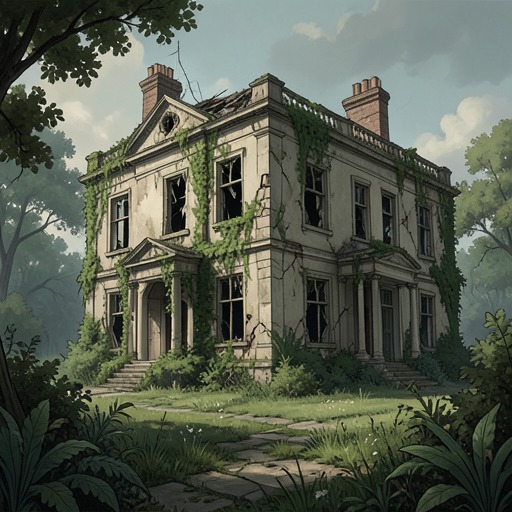
Daniel finds the estate behind a large wrought-iron gate tangled with ivy and dead leaves. A small door set into the bars is locked; above it, the number 32 is twisted into iron shapes like black snakes. The rust running from the keyhole suggests long neglect before Daniel can see anything of the grounds themselves.
Peering through the gate, Daniel makes out a dark tower and a courtyard swallowed by weeds. What first appears to be a fountain or pond contains a stone hand reaching upward, with other limbs and shapes submerged around it. Beyond the overgrowth, a marble staircase lies broken beneath rubble and fallen leaves. The scene reveals the estate not simply as an unused property but as a place whose former grandeur has become difficult to distinguish from a graveyard.
The decay gives visible form to a family’s reversal. Daniel reads the ruined staircase and neglected grounds against the Aldayas’ former glory and fortune, now long vanished. The mansion’s architecture remains, but it no longer signals security or social power: locked access, rust, weeds, and broken stone make abandonment the dominant fact of its appearance.
The Aldayas’ Decline
A caretaker employed by the neighboring Miravells since 1920 offers Daniel a fragmentary account of the family’s fate. He says the Aldayas lost everything at the time of the Republic. His knowledge comes indirectly, from the Miravells, who had once been friends of the family, rather than from close involvement with the Aldayas themselves.
The caretaker believes the eldest son, Jorge, went abroad to Argentina, where the family had factories. In his telling, the Aldayas had been very rich and were the kind of people who always managed to recover their footing. That confident generalization sits uneasily beside the visible ruin: the estate suggests not a temporary setback but the disappearance of the household that once occupied it.
The property, the caretaker says, is still for sale. There has been talk of demolishing it to build a school, and he considers destruction the best solution, arguing that the building should be torn down to its foundations. His proposal treats the mansion’s history not as something to preserve but as a problem to remove. The possibility that a new institution might replace it sharpens the contrast between its former life as an emblem of wealth and its present status as unwanted, supposedly useless ground.
Rumor and the House’s Reputation
When Daniel asks why the caretaker wants the building demolished, the man describes the Aldayas as a shady lot, at least according to what people say. He cannot offer a clear account of their wrongdoing. Instead, he points to stories of noises in the house and to the fear it inspires: he has heard that more than one person has been so frightened inside that they soiled themselves. The estate’s reputation rests on hearsay, not on a verified explanation.
The caretaker presents himself as skeptical of such things, yet he repeats the stories and recommends laying lime over the ground. His position captures the unstable boundary between disbelief and fascination. He dismisses the supernatural while keeping the rumor alive, and his proposed demolition sounds less like an ordinary response to a derelict property than an attempt to erase whatever the house is imagined to contain.
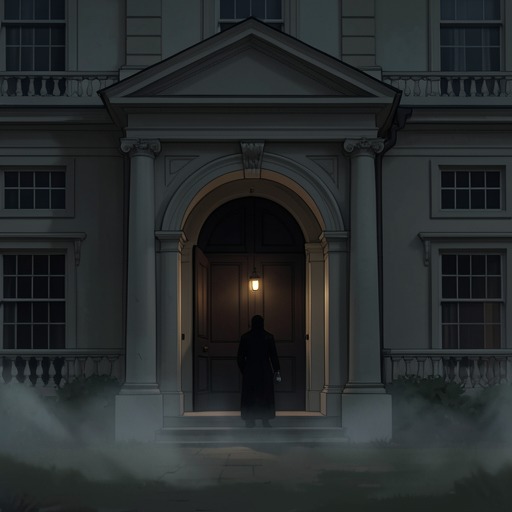
The most elaborate tale comes from the caretaker’s account of a nighttime visit. Friends of Joanet, the Miravells’ son, had heard stories about the mansion and persuaded him to go inside. Joanet, a large young man, then enlisted the caretaker, although the caretaker refused to enter. He says the abandoned house had already stood empty for at least ten years, and he adds that entering it might not be legal. Joanet supposedly climbed to the second floor to impress his girlfriend, then heard what seemed to be a voice in a room. When he tried to enter, the door shut in his face.
Daniel offers a mundane explanation, suggesting a draught. The caretaker counters with the possibility of something else and invokes other mysteries he has heard discussed on the radio. The exchange does not establish that the house is haunted; it shows how an unexplained sound becomes part of the estate’s growing legend. The incident is doubly indirect—Joanet’s experience reaches Daniel through the caretaker—and the story’s uncertain chain of retelling leaves room for fear without resolving it as fact.
Memory, Contrast, and Significance
The estate’s abandonment holds two competing versions of the past in the same frame. The caretaker remembers the Aldayas through the Miravells’ association with a wealthy family and through public talk of disgrace; Daniel sees the present-day evidence of absence in the locked gate, buried fountain figures, and collapsed staircase. Neither account restores the household to view. One preserves fragments of social history, while the other makes its disappearance physically legible.
Daniel’s visit also brings the ruined grounds into contrast with a surviving image of their former life. As he returns toward the station, he thinks of Julián Carax walking along the same road, among facades that may hardly have changed, and takes out the photograph of Penélope Aldaya smiling in the mansion courtyard. In the photograph, Penélope’s expression carries the promise of an untroubled future; at the estate, weeds and rubble have overtaken the place associated with that image. The contrast makes abandonment a loss not only of property but of the world the photograph appears to preserve.
The mansion therefore functions as more than a decaying backdrop. Its material ruin confirms that the Aldayas’ fortune and presence have receded, while the caretaker’s stories make the vacant building an active source of speculation. The wish to raze it, the unverified account of a voice, and the image of Penélope in the courtyard all converge on a place where the past remains visible but cannot be fully recovered. Abandonment has cleared the house of its occupants without clearing away its history.